
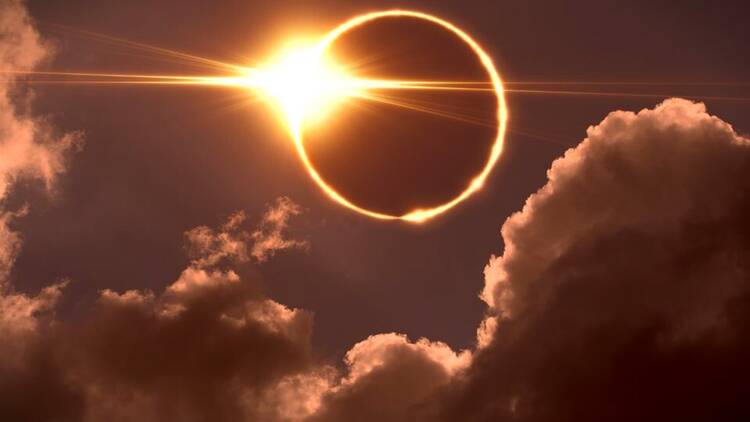
Millions of Americans will be able to see the phenomenon, but only a handful of cities in the “path of annularity,” or the maximum amount of obscuration, will see the “ring of fire” created when the moon lines up perfectly with the sun, leaving only the burning rim visible.
The 2023 solar eclipse will stream live in a player at the top of this article for those well outside of the path of annularity, but if you’re planning on breaking out the eclipse glasses and seeing it for yourself, this map shows viewing times for a number of cities:
If you aren’t able to travel to the 150-mile-wide path of annularity, you can still see a partial view of the eclipse.
The 80-90% range includes portions of California, Nevada, Oregon, Arizona, Utah, Wyoming, Colorado, New Mexico, Oklahoma, Texas and Idaho, for instance.
Moving a little further from the path of annularity, states with a 70-80% view include parts of Washington, Montana, Idaho, Wyoming, Colorado, Kansas, Nebraska, Oklahoma, Louisiana, Texas, Arkansas, California, and Arizona.
In the U.S., the annular eclipse will start at 9:13 a.m. PDT in Oregon and will last be visible in Texas at 12:03 p.m. CDT before moving on to Mexico, Guatemala, Belize, Honduras, Nicaragua and Panama, according to NASA.
The partial eclipse will begin and end later, however. For example, the partial eclipse in Eugene, Oregon, will begin at 8:06 a.m. PDT but annularity won’t start until 9:16 a.m., reaching its maximum two minutes later. The partial eclipse in Eugene ends at 10:39 a.m. PDT.
Post a Comment